Unlock Potential: The Ultimate Guide to STEM Toys for Every Age
Ever watch a child stack blocks with intense focus or marvel at how a simple magnet works? That's the spark of STEM – Science, Technology, Engineering, and Mathematics – in action! In today's rapidly evolving world, equipping our children with critical thinking and problem-solving skills is more important than ever. Educational toys, particularly those centered around STEM principles, are not just about fun; they're powerful tools for nurturing curious minds and building foundational skills that will last a lifetime.
This comprehensive guide will explore the incredible world of STEM toys, demonstrating how they benefit children at every stage of development, from their first wobbly steps to their confident teenage years. We'll delve into age-appropriate recommendations, evidence-based benefits, and practical tips for parents to maximize the learning potential of these fantastic playthings. Get ready to ignite a passion for discovery in your child! this excellent wellness product
What Exactly Are STEM Toys and Why Do They Matter?
STEM toys are specifically designed to introduce children to concepts in Science, Technology, Engineering, and Mathematics through engaging, hands-on play. They move beyond rote memorization, encouraging exploration, experimentation, and discovery. Let's break down what each component fosters:
Science
Fosters curiosity about the natural world, encourages observation, and introduces hypothesis testing.Technology
Introduces digital literacy, basic coding concepts, and understanding how devices and systems work.Engineering
Develops problem-solving skills, design thinking, and structural understanding through building and construction.Mathematics
Builds foundational number sense, spatial reasoning, pattern recognition, and logical thinking.
Why do they matter? Research consistently shows that early exposure to STEM concepts can significantly impact a child's cognitive development, creativity, and future academic and career success. These toys aren't just for future scientists; they cultivate vital transferable skills like critical thinking, collaboration, resilience, and innovation – qualities essential for any path in life. Experts like Dr. Megan M. Franke, a professor of education, emphasize that "children are natural mathematicians and scientists," and STEM toys provide the perfect outlet for this innate curiosity, transforming abstract ideas into tangible, playful experiences.
STEM for the Littlest Learners: Toddlers and Preschoolers (Ages 1-5)
Even before they can spell "STEM," little ones are ready to explore its principles. At this age, play is all about sensory exploration, understanding cause and effect, and developing fundamental motor skills.
How STEM Manifests in Early Childhood Play:
- Science in Play: Simple experiments with water, sand, or light tables. Toys that demonstrate cause and effect (e.g., push a button, something happens).
- Technology in Play: Basic interactive toys that light up or make sounds in response to actions, or simple remote-control vehicles.
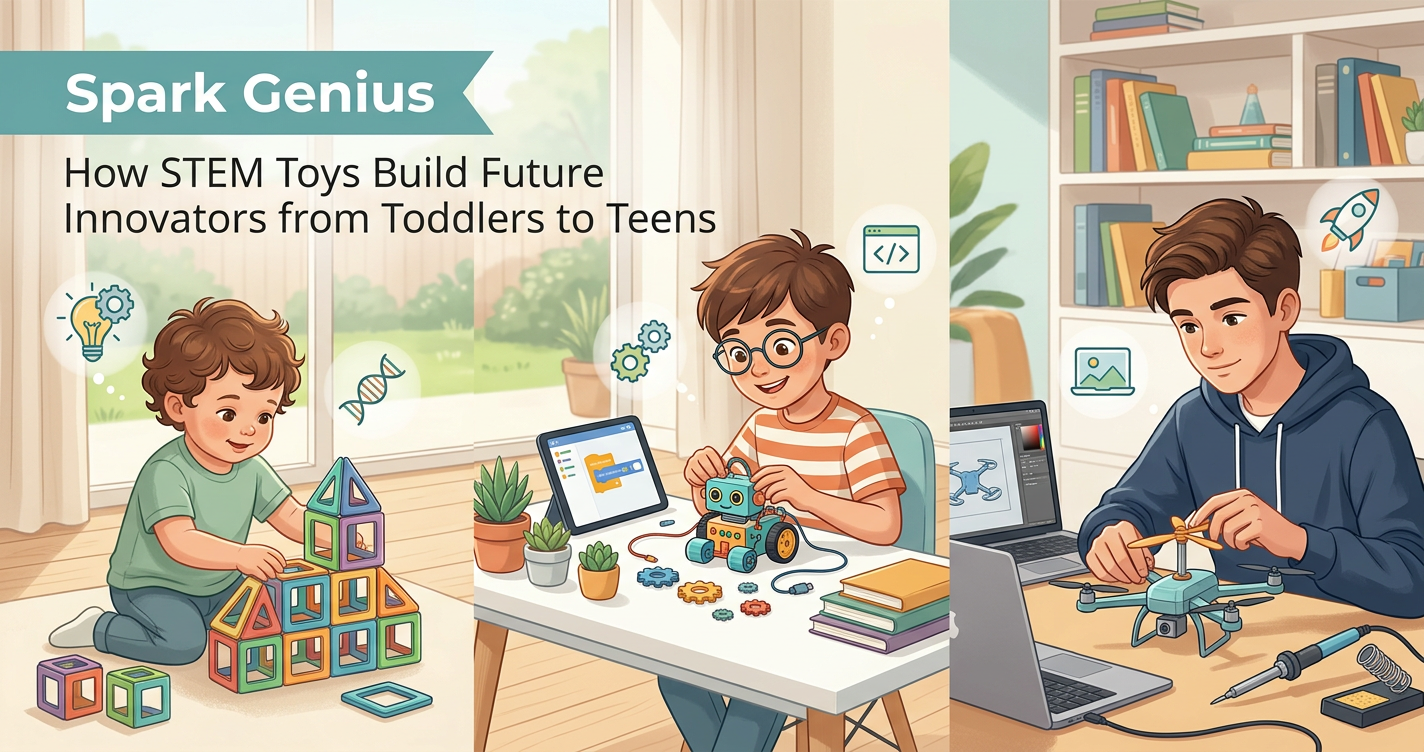
- Engineering in Play: Building blocks (wooden, magnetic, interlocking), shape sorters, stacking toys. These develop spatial reasoning and fine motor skills.
- Math in Play: Counting games, sorting objects by color or size, puzzles that introduce shapes and patterns.
Recommended STEM Toys for Toddlers & Preschoolers:
- Large LEGO DUPLO bricks or similar building blocks
- Magnetic tiles (e.g., Magna-Tiles, Connetix)
- Chunky gears and interlocking construction sets
- Shape sorters and stacking rings
- Simple cause-and-effect electronic learning toys
- Water tables, sand play sets, and child-safe science exploration kits
Key Benefits for Young Children:
- Enhances fine and gross motor skills and hand-eye coordination.
- Boosts early problem-solving abilities and spatial awareness.
- Develops early logical thinking and understanding of patterns.
- Fosters language development through descriptive play and interaction.
Building Blocks of Brilliance: Early School Years (Ages 6-10)
As children enter school, their capacity for abstract thought grows, making this a prime time to introduce more structured STEM challenges. They're ready for more complex tasks, basic coding, and understanding how mechanisms work.
How STEM Grows with Early School-Aged Kids:
- Science in Play: Simple chemistry sets, biology kits (e.g., ant farms, sprout gardens), telescopes, or microscopes designed for kids.
- Technology in Play: Introduction to block coding platforms (like Scratch Jr., Code & Go Robot Mouse) and simple robotics kits (e.g., LEGO WeDo, Sphero Mini).
- Engineering in Play: More intricate building sets (classic LEGO, K'nex, Erector sets), bridge-building challenges, and basic circuit kits.
- Math in Play: Strategy board games, logic puzzles, measuring and estimation activities, and advanced pattern recognition.
Recommended STEM Toys for Early School Years:
- LEGO Classic or Technic sets
- Snap Circuits or other beginner electronics kits
- Beginner robotics kits (e.g., Ozobot, Botley, LEGO Boost)
- Rockery kits or crystal growing kits
- Science experiment kits focusing on physics, chemistry, or biology concepts
- Coding board games or simple programming apps
Key Benefits for School-Aged Children:
- Develops sequential reasoning and critical analysis skills.
- Enhances patience, perseverance, and the ability to follow instructions.
- Introduces early programming logic and computational thinking.
- Fosters an understanding of scientific methods and experimentation.
Inspiring Innovation: Pre-Teens and Teens (Ages 11+)
For older children, STEM toys can transition into more sophisticated tools that mirror real-world applications, fostering deeper understanding and even career exploration. This is where complex problem-solving and independent project work truly shine.
Advanced STEM Exploration for Pre-Teens & Teens:
- Science in Play: Advanced chemistry sets, dissection kits, astronomy kits, weather stations, or renewable energy kits.
- Technology in Play: Advanced coding platforms (e.g., Python, Arduino, Raspberry Pi), drone building and programming, or virtual reality (VR) kits.
- Engineering in Play: Robotics kits with more complex programming and design (e.g., VEX IQ, advanced Arduino projects), model building with intricate mechanics, or 3D printing pens/kits.
- Math in Play: Advanced logic puzzles, strategy games with complex algorithms, and an introduction to geometry and physics concepts through building and experimentation.
Recommended STEM Toys for Pre-Teens & Teens:
- Advanced robotics kits (e.g., LEGO Mindstorms EV3, VEX IQ)
- Arduino starter kits or electronics project kits
- Drone building kits with programming capabilities
- Coding apps or platforms (e.g., Scratch, Python tutorials, Swift Playgrounds)
- Advanced chemistry/physics kits with more complex experiments
- Telescopes with smartphone integration or advanced model building kits
Key Benefits for Pre-Teens & Teens:
- Encourages advanced analytical thinking and complex problem-solving.
- Develops project management and independent learning skills.
- Fosters a deeper understanding of real-world technology and innovation.
- Potentially inspires future academic and career paths in STEM fields.
Choosing the Right STEM Toy: More Than Just Age Recommendations
While age guidelines are helpful, selecting the perfect STEM toy involves more personalized considerations. A toy's true value lies in how well it engages and challenges your individual child.
Child's Interests
What truly fascinates your child? Do they love building, exploring nature, solving puzzles, or playing with gadgets? Aligning with their passions ensures sustained engagement and deeper learning.Learning Style
Is your child a visual learner, a hands-on explorer, or a logical thinker? Some toys naturally suit different learning styles better. Observe how they interact with different types of activities.Open-Ended Play vs. Guided Projects
Open-ended toys (like building blocks or magnetic tiles) encourage imagination, diverse solutions, and endless possibilities. Guided project kits, on the other hand, teach specific skills and concepts through step-by-step instructions. A balance of both is often ideal.Durability and Safety
Always ensure toys are well-made, non-toxic, and appropriate for their age, especially for younger children who might put items in their mouths. Look for reputable brands and recognized safety certifications.Growth Potential
Can the toy be used in multiple ways or adapted as your child's skills advance? Toys that grow with them offer better long-term value and continued challenge, preventing them from being quickly outgrown.
Maximizing the STEM Play Experience: Tips for Parents
Simply buying a STEM toy isn't enough; how you engage with it and facilitate the play experience makes all the difference in unlocking its full potential.
Play Together
Join in! Your enthusiasm is contagious. Work on a project side-by-side, or simply observe and offer encouragement. Shared experiences often deepen learning and bond.Ask Open-Ended Questions
Instead of "What is that?", try "What do you think would happen if...?" or "How could we make this stronger/faster/taller?" This encourages critical thinking, hypothesis formation, and problem-solving.Embrace Experimentation and Failure
STEM is all about trial and error. Let your child experiment freely, and help them see "failures" as valuable learning opportunities. "That didn't work. What did we learn? What can we try next?" This builds resilience and a growth mindset.Connect to the Real World
Point out how STEM principles are at work everywhere – from the engineering of a bridge to the technology in your phone, the science behind cooking, or the mathematics in sports. This makes learning relevant and exciting.Create a STEM-Friendly Environment
Designate a space for creative projects, provide access to various materials (not just toys, but recycled items, craft supplies, and simple tools too), and allow for a bit of mess! A dedicated space signals that exploration is valued.
Conclusion: Sparking a Lifetime of Learning and Innovation
Investing in STEM toys is an investment in your child's future. From the earliest stacking blocks to advanced robotics, these incredible tools do more than just entertain; they ignite curiosity, foster essential cognitive skills, and empower children to become confident problem-solvers and innovative thinkers. By thoughtfully choosing age-appropriate, interest-driven STEM toys and actively engaging in their play, you're not just providing a toy – you're opening a world of possibilities and helping to spark the genius within.
The skills developed through STEM play – critical thinking, creativity, collaboration, and resilience – are foundational for success in any endeavor, not just future STEM careers. So, go ahead, explore the exciting world of STEM toys, and watch your child discover, learn, and grow into the innovators of tomorrow!