
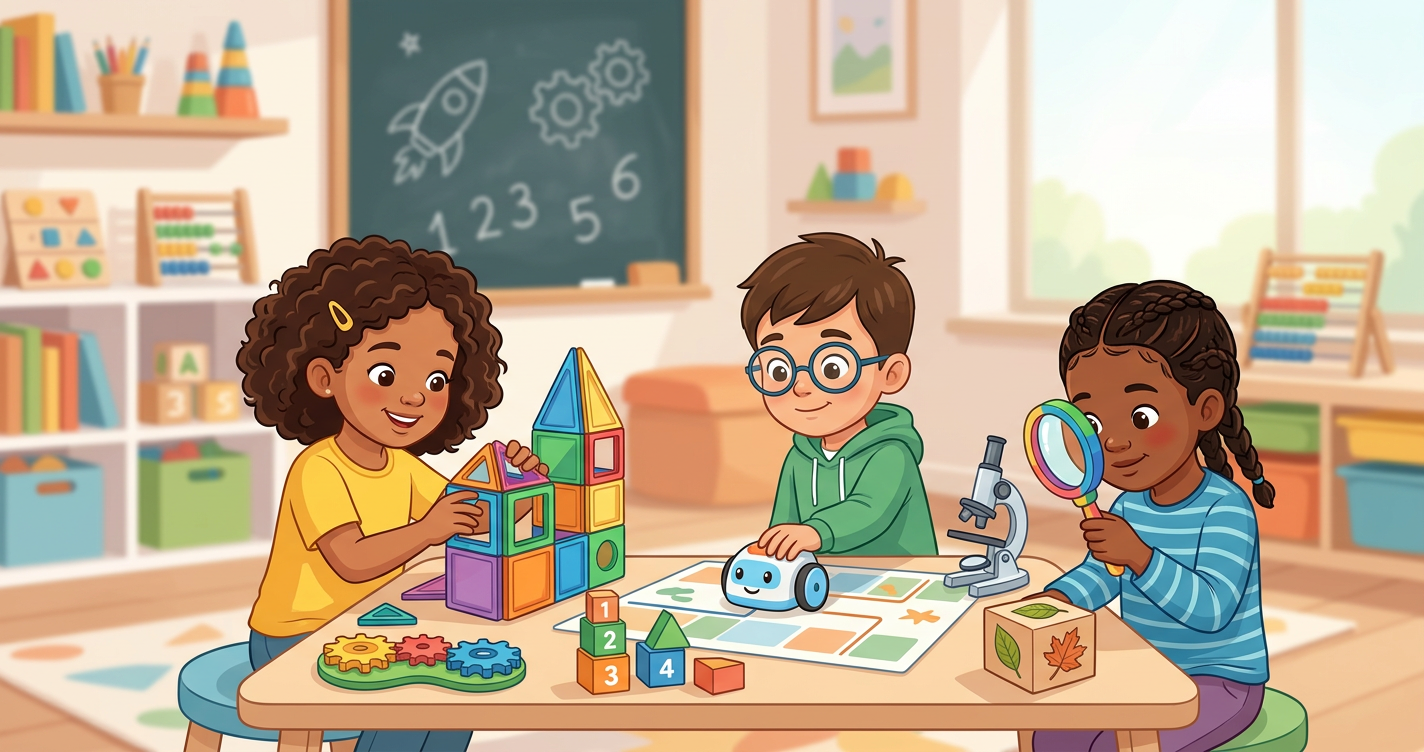
As parents, we all want to give our children the best possible start in life. We nurture their imagination, encourage their dreams, and cheer on their every milestone. But what if one of the most powerful tools for their future success is already in their playroom? We're talking about educational toys, specifically the incredible world of STEM toys for early childhood. These aren't just gadgets; they're gateways to discovery, building foundational skills that last a lifetime.
In a world increasingly driven by innovation and technology, equipping our young learners with a strong grasp of Science, Technology, Engineering, and Mathematics (STEM) isn't just a trend – it's a necessity. But don't let the complex-sounding acronym intimidate you! For preschoolers and young children, STEM learning is simply about exploring, experimenting, and understanding how the world works, all through the magic of play. this excellent toy product
This comprehensive guide will dive into why STEM toys are so vital for your little one's development, how to choose the best ones, and practical tips to maximize their learning potential. Get ready to spark curiosity and watch your child's brilliance shine!
What Exactly Are STEM Toys, Anyway?
Before we explore the benefits, let's clarify what STEM truly means in the context of early learning. STEM stands for:
- Science: Understanding the natural world through observation and experimentation.
- Technology: Exploring tools and how they work, from simple machines to digital devices.
- Engineering: Designing, building, and problem-solving to create solutions.
- Mathematics: Developing number sense, patterns, shapes, and logical reasoning.
A STEM toy isn't necessarily a high-tech gadget (though some are!). It's any plaything that encourages children to engage with these principles hands-on. Think building blocks that teach balance and gravity, simple circuit kits that introduce electricity, or even nature exploration sets that foster scientific observation. The key is that they encourage active participation, critical thinking, and a natural inquisitiveness about how things function.
The Brain-Boosting Benefits: Why STEM Matters So Young
The impact of engaging with educational STEM toys from an early age is profound. Research consistently shows that early exposure to STEM concepts can significantly enhance cognitive development, creativity, and problem-solving abilities. Here’s how:
Problem-Solving & Critical Thinking
When a child tries to make a tower stand tall, figures out how gears connect, or experiments with different materials, they are actively engaging in problem-solving. They learn to analyze situations, hypothesize solutions, and test them out. This iterative process of trial and error builds resilience and teaches them to think critically, a skill invaluable in all aspects of life.
Fostering Creativity & Innovation
STEM isn't just about logic; it's also a powerful driver of creativity. Many STEM toys are open-ended, meaning there's no single 'right' way to play. Building sets, art supplies that explore scientific principles (like color mixing), or simple engineering challenges invite children to imagine, design, and innovate. They learn to think outside the box and bring their unique ideas to life.
Laying Foundational Skills (Math & Science)
Long before formal schooling, STEM toys introduce fundamental concepts in a playful, accessible way. Children learn about cause and effect (science), spatial reasoning (math/engineering), patterns (math), and sequencing (technology/engineering). They count blocks, sort colors, observe changes, and understand balance, all without realizing they're building a strong academic foundation.
Building Resilience & Persistence
Not every experiment works on the first try, and not every block tower stands firm. STEM play naturally involves challenges and occasional failures. Through these experiences, children learn the value of persistence, adapting their approach, and trying again. This cultivates a growth mindset, teaching them that mistakes are opportunities for learning, not reasons to give up.
Preparing for a Future-Ready World
The jobs of tomorrow will increasingly demand STEM literacy. By introducing these concepts early, we're not just preparing children for school; we're preparing them for a future where adaptability, innovation, and technological understanding are paramount. Early exposure makes these subjects familiar and less intimidating, potentially igniting a lifelong passion.
Choosing the Right STEM Toy for Your Little Learner
With so many options, how do you pick the best STEM toys for preschoolers and young children? Here are some key considerations:
Age-Appropriate & Developmentally Aligned
Always check the manufacturer's recommended age. A toy that's too simple might quickly bore your child, while one that's too complex can lead to frustration. Look for toys that challenge them just enough to encourage growth without overwhelming them.
Embrace Open-Ended Play
The best STEM toys are often those that don't have a single prescribed way to play. Toys that can be used in multiple ways, combined with other toys, or adapted for different scenarios encourage deeper engagement and creativity. Think building blocks, magnetic tiles, or simple art supplies.
The Engagement Factor: Keep it Fun!
If it's not fun, they won't play with it. Look for toys with bright colors, interesting textures, or engaging mechanisms that naturally draw your child in. The joy of discovery is what fuels sustained interest.
Safety First & Durability Matters
Ensure all toys meet safety standards, especially for younger children (e.g., no small parts that could be choking hazards). Durable toys that can withstand enthusiastic play are also a smart investment, as they'll last longer and provide more learning opportunities.
Top STEM Toy Categories to Explore
Ready to start building your child's STEM toolkit? Here are some fantastic categories of educational STEM toys to consider:
-
Building & Construction Sets
From classic LEGO DUPLO to magnetic tiles (e.g., Magna-Tiles, Connetix) and wooden blocks, these toys are engineering powerhouses. They teach spatial reasoning, balance, geometry, and problem-solving as children design and construct structures.
-
Early Science Exploration Kits
Simple science kits for kids, magnifying glasses, bug viewers, prism sets, or even just a set of measuring cups and spoons for water play can introduce concepts like observation, properties of matter, and cause-and-effect. Think about kits that explore light, sound, or simple chemistry (like baking soda volcanoes!).
-
Introduction to Coding & Robotics
Don't let 'coding' sound daunting! For young children, this often means screen-free robots (e.g., Code-a-Pillar, Cubetto) that teach sequencing, logic, and directional commands. These toys introduce computational thinking in a fun, tangible way.
-
Math & Logic Games
Counting bears, pattern blocks, geoboards, shape sorters, and simple board games that involve counting or strategy are excellent for developing early math skills, logical reasoning, and number recognition. Look for manipulatives that make abstract concepts concrete.
-
Nature & Outdoor STEM Adventures
The ultimate STEM lab is often right outside your door! Gardening tools, nature scavenger hunt kits, simple telescopes or binoculars, and even just a bucket and shovel for mud play encourage scientific observation, understanding ecosystems, and hands-on exploration of the natural world.
Making the Most of STEM Play: Tips for Parents
Having the right toys is just the beginning. Your involvement can significantly amplify the learning experience. Here’s how you can support your child’s STEM journey:
Join the Fun (But Let Them Lead!)
Sit down and play with them! Your presence validates their efforts and makes learning a shared, joyful experience. However, resist the urge to take over or dictate how they should play. Let them experiment, make mistakes, and discover solutions on their own.
Ask Engaging, Open-Ended Questions
Instead of saying, “That’s a blue block,” try, “What do you think will happen if you put the blue block there?” or “Why do you think that tower fell?” Questions like “How?” and “Why?” encourage critical thinking and deeper exploration.
Celebrate the Process, Not Just the Outcome
Praise their effort, their persistence, and their willingness to try new things, rather than just the final product. “I love how you kept trying different ways to make that bridge stand!” is more impactful than “That’s a great bridge!”
Connect Play to Real-World Experiences
Point out STEM concepts in everyday life. “Look, the bridge we’re driving over is like the one you built with your blocks!” or “Let’s count how many apples we need for the pie.” This helps children see the relevance of their play and reinforces learning.
What the Experts Say: The Educational Consensus
Educators and child development specialists universally agree on the critical role of early STEM engagement. Organizations like the National Association for the Education of Young Children (NAEYC) emphasize that young children are natural scientists and engineers, constantly observing, experimenting, and making sense of their world. Providing them with opportunities and tools, like high-quality STEM toys, simply nurtures these innate abilities.
Early exposure helps demystify these subjects, making them less intimidating as children progress through school. It’s about cultivating a mindset of curiosity, exploration, and innovation that will serve them well in an ever-evolving future.
Conclusion
Investing in STEM toys for early childhood is more than just buying another plaything; it’s an investment in your child’s future. These powerful educational tools empower young minds to explore, question, create, and problem-solve, laying a robust foundation for academic success and lifelong learning.
So, take a look at your child’s playroom with fresh eyes. Are there opportunities to introduce more hands-on exploration? By embracing the magic of STEM through play, you're not just giving them toys – you’re giving them the keys to unlock their full potential and spark a lifelong love of discovery. Happy playing, and happy learning!


