
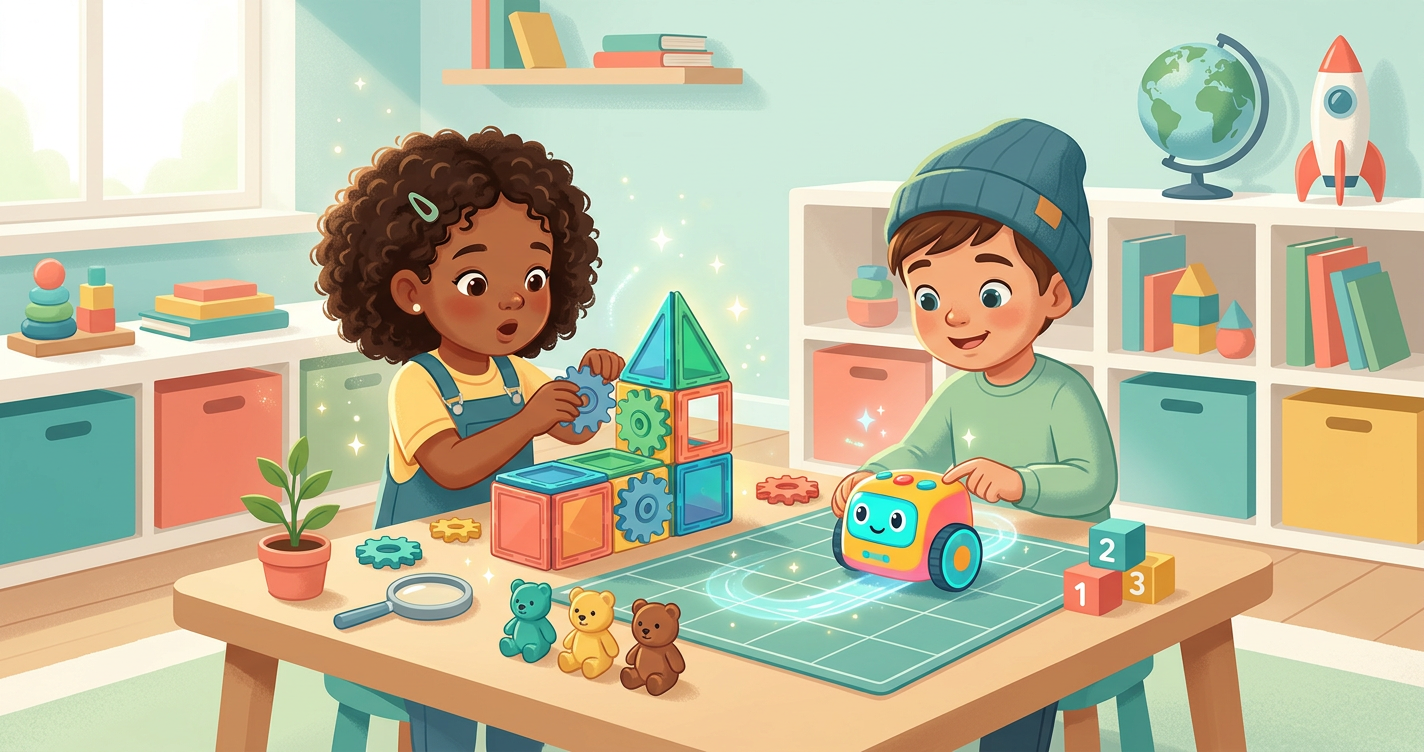
As parents, we all want to give our children the best possible start in life, nurturing their natural curiosity and preparing them for a world that's constantly evolving. In this exciting journey of discovery, one powerful tool stands out: STEM toys for preschoolers. Far from being just a passing trend, these educational gems offer a playful yet profound way to lay foundational skills in Science, Technology, Engineering, and Mathematics, shaping young minds for future success. But what exactly are STEM toys, and why is it so beneficial to introduce them to our little ones even before they step into kindergarten? Let's dive into the fascinating world where play meets purpose, empowering our preschoolers to become the innovators of tomorrow!
What Exactly Are STEM Toys, and Why Start So Young?
STEM is an acronym for Science, Technology, Engineering, and Mathematics. When we talk about STEM toys, we're referring to playthings specifically designed to introduce these concepts in an age-appropriate and engaging manner. Think beyond traditional puzzles and blocks – we're talking about toys that encourage exploration, experimentation, problem-solving, and critical thinking. this excellent toy product
You might wonder, "Isn't preschool too early for complex concepts like engineering or coding?" The beautiful truth is, children are natural scientists and engineers! From the moment they stack a block to see if it falls, or experiment with pouring water, they're engaging in fundamental STEM principles. Introducing structured (but still playful) STEM activities at this age leverages their innate curiosity and capitalizes on a critical period of brain development. Research consistently shows that early exposure to these areas can significantly boost cognitive abilities, improve problem-solving skills, and foster a lifelong love for learning. It's not about formal lessons; it's about hands-on exploration that makes learning feel like magic.
The Science of Play: How STEM Toys Boost Cognitive Development
The benefits of engaging with STEM toys during the preschool years are truly remarkable. These aren't just toys; they're catalysts for cognitive growth:
- Problem-Solving & Critical Thinking: Whether it's figuring out why a tower keeps toppling or how to connect magnetic tiles to form a specific shape, STEM toys constantly present mini-challenges. This encourages children to analyze situations, hypothesize solutions, and test them out, developing crucial logical reasoning skills.
- Spatial Reasoning: Building blocks, construction sets, and even simple puzzles enhance a child's understanding of space, shapes, and dimensions. They learn about balance, symmetry, and how different parts fit together to create a whole, which is fundamental for later mathematical and engineering understanding.
- Creativity & Innovation: Many STEM toys are open-ended, meaning there's no single "right" way to play. This freedom encourages children to imagine, design, and create unique structures or solutions, fostering their imaginative capacity and innovative spirit.
- Cause and Effect: Simple science kits or toys involving gears and levers help children understand how actions lead to reactions. "If I push this button, what happens?" "If I turn this gear, how does it affect the others?" This understanding is a cornerstone of scientific inquiry.
- Early Math Concepts: Counting, sorting, pattern recognition, and understanding quantity are all subtly integrated into STEM play. Building with a specific number of blocks or sorting objects by size and color lays essential groundwork for formal mathematical learning.
By providing these experiences, we're not just entertaining our children; we're actively building neural pathways that will serve them throughout their academic and professional lives.
Beyond Academics: The Holistic Benefits of STEM Play
While the cognitive advantages are significant, the impact of STEM toys extends far beyond academic preparation. They play a vital role in a child's holistic development:
- Fine Motor Skills: Manipulating small parts, connecting pieces, and precise placements all strengthen the tiny muscles in a child's hands and fingers, crucial for tasks like writing, drawing, and self-care.
- Patience & Perseverance: Not every experiment works on the first try! STEM play teaches children that mistakes are part of the learning process. They learn to try again, adjust their approach, and persist until they achieve their goal, building resilience and a growth mindset.
- Language Development: As children play, they often describe their actions, ask questions, and narrate their discoveries. Parents and caregivers can enhance this by asking open-ended questions like, "What are you building?" or "How did you make that work?" enriching their vocabulary and communication skills.
- Social-Emotional Growth: Many STEM toys are fantastic for collaborative play. Children learn to share, take turns, communicate their ideas, and work together to solve a problem or build something grand. This fosters empathy, cooperation, and the ability to navigate social dynamics.
- Confidence: Successfully completing a challenge, building a sturdy structure, or making a discovery gives children a powerful sense of accomplishment. This boosts their self-esteem and encourages them to tackle new challenges with enthusiasm.
It’s clear that STEM toys are not just about creating future scientists; they're about raising well-rounded, confident, and capable individuals.
Choosing the Right STEM Toys for Your Little Learner
With so many options available, how do you pick the best STEM toys for your preschooler? Here are some friendly tips to guide your choices:
- Age-Appropriateness is Key: Always check the recommended age range. Toys that are too complex can lead to frustration, while those that are too simple might not be engaging enough. Look for toys with large, easy-to-handle pieces for younger preschoolers.
- Prioritize Open-Ended Play: The best STEM toys allow for multiple possibilities and encourage imagination rather than following strict instructions. Think building blocks, magnetic tiles, simple gear sets, or open-ended construction kits.
- Safety and Durability: Ensure toys are made from non-toxic materials, have no small parts that pose a choking hazard for young children, and are sturdy enough to withstand enthusiastic play.
- Engage Their Interests: If your child loves animals, look for science kits that explore nature. If they're fascinated by vehicles, consider construction sets that build cars or planes. Tapping into their passions makes learning even more exciting.
- Consider Variety: A mix of toys that focus on different STEM areas (e.g., a building set for engineering, a simple magnifying glass for science, a shape sorter for math) will provide a richer learning experience.
- Examples of Great STEM Toys for Preschoolers:
- Building Blocks (wooden, LEGO DUPLO, Magna-Tiles): Excellent for engineering, spatial reasoning, creativity.
- Simple Gear Sets: Introduces concepts of mechanics, cause and effect.
- Beginner Robotics/Coding Toys (e.g., Code & Go Robot Mouse, Botley): Introduces sequencing, problem-solving, early coding logic.
- Junior Science Kits: Often include magnifying glasses, pipettes, test tubes for safe exploration of the natural world.
- Pattern Blocks & Shape Sorters: Develops mathematical concepts, fine motor skills.
Integrating STEM Play into Daily Life: Tips for Parents
Buying the toys is just the first step! The real magic happens when you engage with your child and make STEM a natural part of your daily rhythm:
- Play Together: Join in the fun! Your enthusiasm is contagious. Play alongside your child, ask questions, and model curiosity.
- Ask Open-Ended Questions: Instead of telling them what to do, ask questions like, "What do you think will happen if...?" "How could we make this stronger?" "What other ways could we solve this problem?" This encourages them to think critically.
- Connect to the Real World: Point out STEM concepts in everyday life. "Look at that bridge, it's like the one we built with our blocks!" "Why do you think the ball rolls faster down this ramp?"
- Embrace Mistakes as Learning Opportunities: When a tower falls or an experiment doesn't work, frame it positively. "That didn't work the way we expected! What can we try differently next time?" This teaches resilience and the iterative nature of problem-solving.
- Create a "Discovery Zone": Designate a space where STEM toys are easily accessible and messes are acceptable. This encourages independent exploration.
- Focus on the Process, Not Just the Product: Celebrate their efforts, their thinking, and their persistence, not just the final outcome. The learning happens in the journey.
Dispelling Myths: STEM Isn't Just for "Smart Kids"
It's crucial to remember that STEM is for *every* child. There's a common misconception that STEM fields are only for those who are inherently "good at math" or "super logical." This couldn't be further from the truth, especially at the preschool level. Early STEM exposure is about fostering curiosity, encouraging exploration, and building confidence in problem-solving – skills that benefit everyone, regardless of their future career path. We're not trying to create child prodigies; we're simply giving them tools to explore the world around them in a meaningful way. Avoid pressure and focus on making learning joyful and accessible.
Ready to Build a Brighter Future?
The preschool years are a precious window of opportunity, a time when children are incredibly receptive to new ideas and eager to explore. By thoughtfully incorporating STEM toys for preschoolers into their play, we're doing more than just entertaining them; we're investing in their cognitive development, fostering essential life skills, and igniting a lifelong passion for discovery. So go ahead, embrace the power of playful learning, and watch your little ones build, experiment, and imagine their way to a brighter, more innovative future!


